The sump comes off every time

Wet Belt Replacement in Dudley

A timing belt that runs inside your engine, in the oil. It does not snap like a cambelt — it sheds, and the debris blocks the oil pickup until the engine starves. We do these properly, which means the sump comes off and the strainer gets cleaned.

From £450Genuine or OEM parts only12-month parts warranty

Wet belt replacement from

£450

Sump off and pickup strainer cleaned

Belt, tensioner and idlers as a set

Fresh oil and filter, because the old oil is full of belt

The honest bit

Swapping the belt is not the job.

A wet belt does not usually fail because it wore out. It fails chemically. As engine oil ages it turns acidic, and with fuel dilution from short journeys and years of heat cycles, the surface of the belt softens and starts to break down.

It does not crack like an old cambelt. It sheds. And because the belt is already sitting in your oil, there is no filter between it and the sump — those particles circulate, settle, and build up on the oil pump pickup strainer at the bottom of the engine.

That strainer is the last thing between your sump and your oil pump. Block it and oil pressure drops, and the bearings, camshafts and turbo start running dry. That is the failure: not bent valves, but oil starvation, from rubber your own belt shed into your own oil.

Which is why a quote that does not include dropping the sump is not a quote for this job. We have seen cars come to us having had a belt done elsewhere twelve months earlier, and lose the engine anyway.
Do you have one?

The engines we see most

Keith spent 40 years as a Vauxhall main-dealer technician, so the PureTech family in particular is very much his speciality.

Ford 1.0 EcoBoost petrol

2012 onwards

Fiesta, Focus, EcoSport, B-Max, C-Max, Mondeo, Transit Courier and Transit Connect

Interval: Sold as a lifetime part originally, then 15 years, then 10. Ford’s current guidance for many variants is 10 years or 100,000 miles.

Stellantis 1.0 and 1.2 PureTech petrol

Belt-driven versions carry engine codes starting EB2

Vauxhall Corsa, Mokka, Crossland and Grandland; Peugeot 208, 2008, 308 and 3008; Citroën C3, C4 and Berlingo; and DS models

Interval: Cut hard, to around 6 years or 62,000 miles. The oil specification is not optional on these and it has to be changed annually.

Ford 2.0 EcoBlue diesel

Transit, Transit Custom and Tourneo

Vans and people carriers using the 2.0 EcoBlue

Interval: Dropped to 6 years or 100,000 miles, down from 10 years or 150,000, specifically because of oil dilution during DPF regeneration.

The bit almost every other article gets wrong

Ford revised the 1.0 EcoBoost around 2018–2019 to drive the camshafts with a timing chain — the version you will find in the Puma and later Fiestas and Focuses, often identifiable by the turbo sitting at the back of the engine rather than the front. Stellantis moved the 1.2 to a chain from 2023. So owners get told “you have a chain, you are fine” and stop worrying.

On most of those revised engines the oil pump is still driven by a wet belt. Better belt, better tensioner, smaller and cheaper job — but still a rubber belt sitting in your oil with a service life. It still sheds. It still needs doing.

When it is due

Every one of these intervals has been revised downwards

In some cases more than once, which tells you the original numbers were optimistic. The second thing worth taking from it is that the years matter more than the miles.

We see belts that have shed badly on cars with 45,000 miles on them, because the car is eleven years old and has spent most of its life doing three-mile trips. Time and oil quality do the damage, not distance. Short-journey cars suffer worst — if the engine never gets properly hot, the oil degrades faster and fuel dilution is worse. Around here, that describes most people’s driving.

Our honest rule of thumb

Get it inspected at eight years. Replace it at ten, regardless of what the mileage says. On a PureTech, bring both of those forward.

And keep the oil right. On a PureTech the correct PSA-spec oil, changed annually, is not optional — it is the single cheapest thing protecting the belt.

Listen for these

Warning signs

  • A whine or whirr from the front of the engine, usually worse under load
  • The oil light flickering, especially on roundabouts, braking or cornering
  • Low oil pressure warnings, or a "STOP" or anti-pollution message
  • Rough running, misfires, or a rattle on cold start
  • Oil consumption that has crept up without an obvious leak
  • Black rubbery debris on the oil filler cap or dipstick, or specks in the drained oil

If you get an oil pressure warning on one of these engines, stop and call somebody. Don’t drive it home. Ten minutes of driving on low oil pressure is the difference between a belt job and an engine.

Step by step

What a proper wet belt replacement involves

This matters, because it is where the cheap quotes come from. If a price looks suspiciously low, one of these is usually missing.

  1. 1

    Confirm the engine actually has one

    From the registration and engine code, because the same model can have a wet belt one year and a chain the next. Free, and it takes about a minute.

  2. 2

    Timing cover off and the old belt inspected

    We look at how much material the belt has already lost. That tells us what has been circulating in the oil and how urgent the rest of the job is.

  3. 3

    Sump off, pickup strainer cleaned or replaced

    The step that saves the engine, and the step cheap quotes leave out. The strainer is the mesh filter between your sump and your oil pump, and it is where shed belt material collects.

  4. 4

    Belt, tensioner and idlers replaced as a set

    Genuine or OEM parts only. Pattern parts on a belt that lives in hot oil is a false economy we are not interested in.

  5. 5

    Oil pump drive belt done where one is fitted

    On many chain-driven versions of these engines the oil pump is still belt-driven. Smaller job, same principle, done at the same time.

  6. 6

    Re-time with the proper locking tools

    Camshafts and crankshaft locked and re-timed to spec, not by eye and not by marks alone.

  7. 7

    Fresh oil, then pressure checked and road tested

    The old oil is full of belt, so it goes, along with the filter. Then oil pressure is verified, a diagnostic scan run, and the car road tested before it goes back.

What it costs

Wet belt replacement pricing

Indicative wet belt replacement prices by engine family
EngineTypical price
Stellantis 1.2 PureTech£450–£850
Ford 1.0 EcoBoost£650–£1,200
Ford 2.0 EcoBlue (Transit)£800–£1,500

Indicative ranges including the sump coming off and the strainer being dealt with. Prices vary with the engine, the model and what we find once we are in there, so ring us with the registration for a proper quote on your car rather than treating these as gospel.

It is not a cheap job. We are not going to pretend otherwise.

Set it against a replacement engine, which starts around £2,500 fitted for a small petrol and climbs quickly, plus recovery, plus a couple of weeks without a car. On a ten-year-old Fiesta, an engine failure usually writes the car off in practical terms.

It is the cheapest version of this problem you will ever be offered.

From the workshop

What we've sorted recently

Real jobs off our ramps, described by the mechanic who did them.

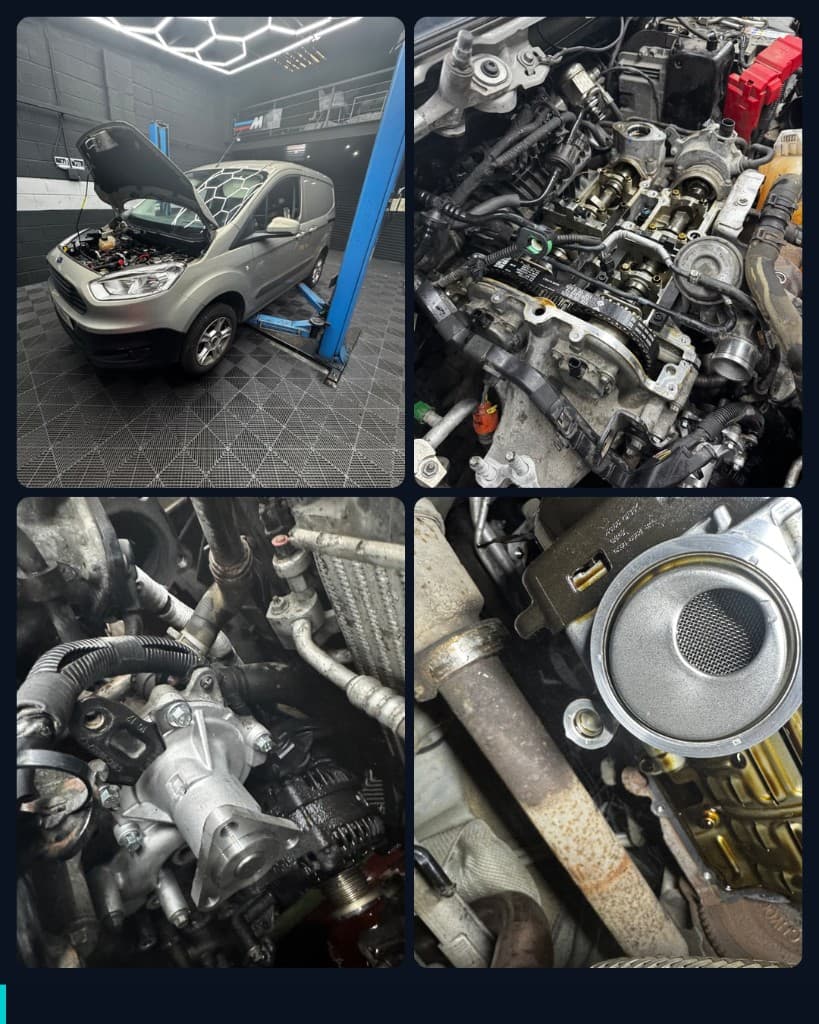
Close-up of the degraded wet timing belt lifted out of the DS 3 engine, alongside the exposed timing assembly, the oil strainer and the car on the workshop ramp with its bonnet up
DS 3 1.2 PureTech, 2017Wet belt and oil strainer

A wet belt job where the real problem was the oil strainer: DS 3 1.2

A 2017 DS 3 in the Dudley workshop for a wet belt. DS was Citroën’s premium line before it was spun off as a marque of its own, so you will still see these listed and sold as a Citroën DS3, and the 1.2 PureTech engine in it is shared right across Citroën, Peugeot and Vauxhall.

That engine is why this job matters. On these the timing belt does not sit out at the front behind a plastic cover like a conventional cambelt. It runs inside the engine, submerged in oil.

That is also why they fail differently. As the belt material breaks down it does not snap, it sheds, and the debris travels through the oil system until it reaches the oil strainer, which is the mesh filter the oil passes through before it gets pumped around the engine. That is exactly what we found here, and Elliot is blunt about it: the strainer is the real failure point, and getting it properly clean is vital.

The reason it matters more than the belt is simple. A blocked strainer restricts oil flow, and starving an engine of oil does far more damage than a tired belt ever will. So the strainer was cleaned out thoroughly, then a new wet belt went on.

Car back on the road afterwards. Worth knowing if you run anything with the 1.2 PureTech in it, whether that badge says DS, Citroën, Peugeot or Vauxhall, because the condition of that strainer matters just as much as the belt itself.

Want the full background first?

Keith wrote a long explainer on wet belts: which engines have one, why the intervals keep being cut, what the manufacturers are and are not admitting, and how to buy a used one sensibly. It is the detail behind this page.

Wet Belts Explained: the repair hiding inside your Ford, Vauxhall or Peugeot

If your engine turns out to have a conventional cambelt or a timing chain instead, timing belt and chain replacement starts at £295.

Common questions

Wet belts, answered

Does my car definitely have a wet belt?

Give us the registration and we will tell you. It depends on the exact engine and build date rather than the model, which is why so much of the information online is wrong. It is a free phone call, not a job.

My car has a timing chain, so I am fine, right?

Probably not entirely. Ford revised the 1.0 EcoBoost around 2018–2019 to drive the camshafts with a chain, and Stellantis moved the 1.2 to a chain from 2023. But on most of those revised engines the oil pump is still driven by a wet belt. It is a better belt and a smaller job than a full timing belt, but it is still a rubber belt sitting in your oil with a service life.

Why does the sump have to come off?

Because the damage a wet belt does is not to the belt, it is to your oil system. The belt sheds rubber straight into the oil, and that debris collects on the oil pump pickup strainer. Replace the belt without cleaning the strainer and the rubber already in the engine will block the new one within a few thousand miles. We have seen cars lose engines twelve months after having a belt done elsewhere.

Can you check the belt without stripping the engine?

Partly. We can drop the sump and inspect the pickup strainer, which tells us a great deal about what the belt has been doing, and we can check oil pressure and look at the oil itself. A proper look at the belt means the timing cover coming off.

Can you do it at my house?

No. This one comes into the workshop at Turner Street. Some jobs should not be done on a driveway and this is firmly one of them.

What we can do on a driveway

How long does it take?

Usually a full day in the workshop, sometimes two depending on the engine and what we find when the sump comes off. Collection and return across the Black Country is included.

I have already paid for one of these repairs. Can I claim anything back?

Possibly. Stellantis runs a compensation portal for 1.0 and 1.2 PureTech owners who paid out for premature timing belt failure or excessive oil consumption on work carried out between 1 January 2022 and 31 December 2024, and has extended the warranty on earlier PureTech engines to up to 10 years or 112,000 miles. There are conditions and it will not cover everybody, but if you have the invoices it costs nothing to try. For Ford owners, the US regulator’s investigation into the 1.0 EcoBoost is still open; nothing equivalent is confirmed for UK cars, but keep every invoice.

I am buying a car with one of these engines. Should I walk away?

No — buy it with evidence. Ask whether the wet belt has been done and to see the invoice showing the sump came off, not just a service book stamp. If it has not been done and the car is past six years old on a PureTech or eight on an EcoBoost, treat it as roughly £600 off the asking price rather than a dealbreaker.

Have it checked before you buy

Where we work

Wet belt work across the Black Country

Collection and return from all of these. The work itself is done at our Turner Street workshop in Dudley — never on a driveway.

This is for you if…

  • You drive an EcoBoost, PureTech or EcoBlue and have never had the wet belt done
  • Your car is eight years old or more, whatever the mileage says
  • You have heard a whine, or seen the oil light flicker on a roundabout
  • You want the strainer dealt with, not just the belt swapped

We are probably not your best call if…

  • You want it done on your driveway. This one is workshop-only, without exception
  • You are shopping purely on price. The sump coming off is what you are paying for
  • The engine has already failed from oil starvation — that is an engine assessment first, and we will be straight with you about whether the car is worth it

Send us the reg and we will tell you what you have got.

We do these regularly, we do the sump and the pickup every time, and we will tell you honestly if yours can wait another year.

WhatsApp us