Three jobs, one name

Timing Belt, Chain and Wet Belt Replacement in Dudley and the Black Country

“Timing belt” covers three completely different components that fail in three completely different ways. Before we quote anything, we tell you which one your engine actually has.

Dry cambelts from £29512-month parts warrantyCollection and return

Not sure which you have?

Send us the registration

We identify belt, chain or wet belt from the engine code

Takes about a minute, and costs nothing

You get the real interval for your engine, not the model

The honest bit

Why two “timing belt” quotes can be £700 apart.

Because they are often not quoting for the same job. A dry cambelt on a small petrol engine and a wet belt on a 1.2 PureTech are both called timing belts, and one costs three times the other.

A dry cambelt sits outside the engine behind a cover. A chain sits inside it, in oil, and is not a scheduled job at all. A wet belt is the awkward one in the middle: a rubber belt, like a cambelt, but running inside the engine submerged in oil.

They fail differently too. A cambelt snaps and bends valves. A chain stretches and rattles. A wet belt does neither — it sheds material into your oil until the pickup strainer blocks and the engine starves.

So the first thing we do is establish which of the three you have. That is a free phone call with your registration, and it decides the interval, the job and the price.
Start here

Which one does my car have?

The same model can have a belt one year and a chain the next, so this comes down to the engine and the build date rather than the badge. Here is what each one is.

A dry cambelt

Where it sits
Outside the engine, at the front, behind a plastic cover. Dry.
How it fails
It snaps. On an interference engine the valves then meet the pistons and the top end is wrecked.
When it is due
Every 60,000–100,000 miles or 4–6 years, whichever comes first.
Typically found on
Most petrol and diesel engines built before the mid-2010s, and plenty since.
Cost
From £295, rising with engine size and complexity.

A timing chain

Where it sits
Inside the engine, running in oil. Metal, not rubber.
How it fails
It stretches rather than snapping, and gets progressively noisier. A rattle on start-up is the usual first sign.
When it is due
No scheduled interval. It is meant to last the life of the engine — but only on clean oil at the right level.
Typically found on
Common on BMW, Mercedes, many Vauxhall petrols, and most modern engines from around 2016.
Cost
Quoted after inspection, because it depends on what the noise turns out to be.

A wet belt

Where it sits
Inside the engine, submerged in the oil. A rubber belt where you would expect a chain.
How it fails
It sheds rather than snaps. The debris blocks the oil pump pickup strainer and the engine dies of oil starvation.
When it is due
Revised down repeatedly by the manufacturers. Our rule: inspect at 8 years, replace at 10, sooner on a PureTech.
Typically found on
Ford 1.0 EcoBoost, Ford 2.0 EcoBlue, and the Stellantis 1.0/1.2 PureTech across Vauxhall, Peugeot, Citroën and DS.
Cost
From £450. A different job to a cambelt, not a cambelt with a different price.

If it is a wet belt, read this before you take any quote

A wet belt job that does not include dropping the sump and cleaning the oil pump pickup strainer is not the job. The rubber the old belt has already shed is still in the engine, and it will block the new strainer within a few thousand miles. It is the step cheap quotes leave out, and the reason we price these separately.

Wet belt replacement, from £450

The scheduled one

Dry cambelt replacement, from £295

The conventional job: a rubber belt at the front of the engine, replaced on a schedule rather than in response to a symptom. Most manufacturers specify every 60,000–100,000 miles or 4–6 years, whichever comes first — and the years matter as much as the miles, because age degrades rubber whether you drive the car or not.

What goes in

  • Genuine or OEM-quality timing belt, never a pattern part
  • Tensioner and idler pulleys as part of the same kit
  • Water pump where the belt drives it and it makes sense to do now

What gets checked

  • Auxiliary and ancillary belts while everything is accessible
  • Cooling system pressure-checked and bled after refill
  • Oil leaks from the timing cover and cam or crank seals

What you get back

  • A fixed price agreed before work starts, not an estimate that moves
  • 12-month warranty on the parts we supply
  • The old belt, if you want to see the state it was in

How long it takes

  • Three to four hours for most engines, longer where a mount has to come out
  • Collection and return across the Black Country so you are not sat waiting
  • A realistic timescale confirmed when we confirm the quote
Indicative dry cambelt replacement prices by engine type
EngineTypical price
Small petrol engines£295–£395
Larger petrol engines£395–£595
Diesel engines£450–£750
Water pump fitted at the same timeadd £100–£150

Indicative ranges for a dry cambelt, including belt, tensioners and labour. Wet belt engines are priced separately and start higher. You get a fixed quote for your car before any work starts.

The unscheduled one

Timing chains: no interval, but not maintenance-free

A chain is metal, sits inside the engine, and is designed to last the life of the car. That is why there is no replacement interval and no schedule to fall behind on.

What it does depend on is oil. A chain runs on a film of clean oil at the right level, and on engines that have missed services or run low, chains stretch. A stretched chain rattles — usually worst on a cold start — and left long enough it pulls the valve timing far enough out to affect how the engine runs.

Because it is a symptom-led job rather than a scheduled one, we quote a chain after inspecting it. A rattle from the front of an engine can be a chain, a tensioner, an idler bearing or an ancillary, and those are four different prices.

If you can hear a rattle

Get it identified rather than guessing. A diagnostic check starts at £45, and finding out it is a tensioner rather than a chain is the cheapest outcome of the day.

When we do replace a chain, it goes back together with an oil and filter service, because clean oil is the only thing protecting the new one.

What a diagnostic check covers

Listen for these

Warning signs, and what each one usually means

A dry cambelt rarely warns you before it goes, which is why it is replaced on time rather than on symptoms. Chains and wet belts do give you notice — if you know what you are listening for.

A rattle from the front of the engine, worst on cold start

The classic stretched timing chain. It will not fix itself and it only gets louder — left long enough a stretched chain starts to affect how the engine runs.

A whine or whirr that rises with load

On a wet belt engine this is one to take seriously straight away. It can also be a failing tensioner or idler bearing on a conventional cambelt.

The oil light flickering on roundabouts or under braking

On a wet belt engine, stop driving and call us. This is the signature of a blocked oil pickup strainer, and ten minutes more driving is the difference between a belt job and an engine.

Black rubbery specks on the dipstick or filler cap

Belt material in your oil. There is no filter between a wet belt and your sump, so anything the belt sheds ends up circulating.

Oil weeping from the timing cover

A leaking cam or crank seal will contaminate a dry cambelt and shorten its life considerably. Worth doing with the belt while the front of the engine is already apart.

You simply cannot remember when it was last done

The most common reason people call, and a completely reasonable one. Give us the registration and the mileage and we will tell you where you stand.

Step by step

How the job actually runs

  1. 1

    Confirm what your engine actually has

    From the registration and the engine code we establish whether you have a dry cambelt, a chain, or a wet belt. This is a phone call, not a chargeable job, and it decides everything that follows.

  2. 2

    Agree the kit and quote it in writing

    Belt, tensioner and idlers as a set, with the water pump priced as a visible separate line so you can see what it adds rather than finding it in a total.

  3. 3

    Strip down to the timing assembly

    Covers, ancillary belts and whatever else sits in front of the timing case comes off. On some engines that means supporting the engine and removing a mount, which is why a few of these are workshop-only.

  4. 4

    Lock the engine and replace the set

    Camshafts and crankshaft locked with the correct tools for that engine, then the belt, tensioner and idlers replaced together. Nothing is reused to shave the quote.

  5. 5

    Water pump, where it is driven by the belt

    Fitted at the same time where it shares the labour, adding roughly £100–£150 now instead of the full strip again later.

  6. 6

    Re-time, refill and road test

    Timing checked against the marks, cooling system refilled and bled so there is no trapped air, then a diagnostic scan and a road test before the car goes back.

From the workshop

What we've sorted recently

Real jobs off our ramps, described by the mechanic who did them.

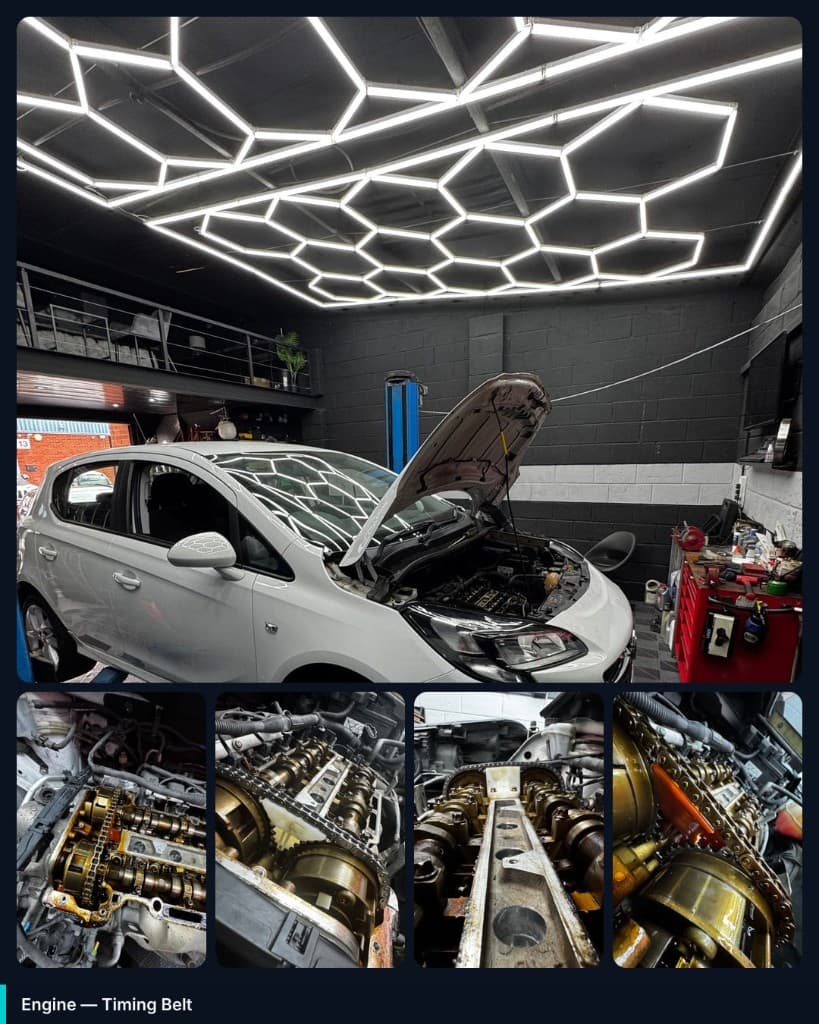
Vauxhall Corsa on the ramp with the bonnet up under the workshop lights, alongside close-ups of the exposed camshafts and the worn timing chain and sprockets
Vauxhall Corsa 1.4 16v, 2018Timing chain, oil and filter

A rattle that turned out to be a stretched timing chain: Vauxhall Corsa

A 2018 Corsa came in with a rattle from the engine. The customer had noticed it and wanted to know what it was before it got any worse, which is exactly the right call.

On diagnosis the timing chain was worn and stretched. Chains do not have a replacement interval the way a belt does, so they tend to get treated as lifetime parts, but they still depend on clean oil at the right level to last. This one had gone without the maintenance it needed for long enough to stretch.

We replaced the chain and it had an oil and filter service at the same time, because fresh oil is the thing that protects the new one.

The rattle has gone and it is back on the road. If you hear a rattle from the front of the engine, get it looked at rather than hoping it settles down. A stretched chain only gets noisier, and left long enough it starts to affect how the engine runs.

Volkswagen CCEngine rebuild after cambelt failure

What it looks like when the belt goes first: Volkswagen CC

This is the job we are trying to talk you out of needing. The cambelt on this Volkswagen CC snapped while the engine was running.

On an interference engine — which most are — that is the end of it. With nothing keeping the camshaft and crankshaft in step, the valves met the pistons. The top end was wrecked.

What should have been a few hundred pounds of scheduled belt change became a full engine rebuild to get the car back on the road. We did the rebuild and it is driving again, but nobody chooses this route on purpose.

If you cannot remember when your cambelt was last changed, that is the sign to get it checked before it decides for you.

Range Rover Evoque 2.2 dieselTiming belt and water pump kit

Belt and water pump done together: Range Rover Evoque 2.2

Cambelt day for this Evoque: a fresh timing belt and water pump kit on the 2.2-litre diesel, done to schedule rather than in response to a symptom.

The water pump went in at the same time because the belt drives it, which means the labour to reach one is the labour to reach the other. Doing it now costs a little more. Doing it separately in a year costs the whole strip again.

A timing belt rarely gives you a warning before it goes, and when it does go the damage runs into proper money. Replacing it on schedule is how you never find out what your engine does at the roadside.

This is for you if…

  • Your cambelt is due by age or mileage and you would rather do it than gamble on it
  • You have a rattle or a whine and want it identified before it becomes an engine
  • You drive a Ford EcoBoost, a PureTech, or a Transit EcoBlue and have never had the wet belt done
  • You want the water pump, tensioner and idlers considered properly rather than belt-only

We are probably not your best call if…

  • The belt has already snapped — that is an engine assessment first, and we will be honest about whether the car is worth the repair
  • You want the cheapest belt-only quote in the Black Country. We fit the kit, and on wet belts we drop the sump
  • You need it done on your driveway. Some cambelts we can do mobile, but chains and wet belts come to Turner Street

Common questions

Belts, chains and wet belts, answered

Does my car have a timing belt, a timing chain, or a wet belt?

Give us the registration and we will tell you in about a minute. It depends on the exact engine and build date rather than the model, which is why so much of the information online is wrong — the same badge on the same car can have a belt one year and a chain the next. It is a free phone call, not a job.

What happens if my timing belt snaps?

On most engines, major internal damage. The valves meet the pistons, and you are looking at a rebuild or a replacement engine rather than a repair. That is the whole reason cambelts are replaced to a schedule instead of when they fail.

My car has a chain, so I never need to worry about it?

Not quite, on two counts. Chains stretch with age and poor oil condition, and a stretched chain rattles and eventually affects how the engine runs. And on a lot of newer chain-driven engines the oil pump is still driven by a wet belt — a smaller job than a full timing belt, but still a rubber belt sitting in your oil with a service life.

Wet belt replacement, and which engines have one

Should I replace the water pump at the same time?

Where the belt drives it, yes, and we will say so. It needs identical labour to reach, so doing it alongside the belt adds roughly £100–£150 now rather than paying for the full strip again if it fails six months later. If yours was recently replaced we will leave it alone.

How long does a cambelt take?

Three to four hours for most engines. Some need an engine mount removed to get at the belt, which adds time, and we will tell you which yours is when we quote rather than after.

Can you do it at my house?

Some straightforward cambelts, yes. Anything needing the engine supported or a mount removed comes to the workshop, and wet belts and chains are workshop jobs without exception — the sump has to come off a wet belt engine, and that is not driveway work.

What we can and cannot do on a driveway

There is a rattle from the front of my engine. Is that the belt?

More often a stretched timing chain, or a tensioner or idler bearing on the way out. It is worth identifying properly rather than guessing, because those are three different jobs at three different prices. A diagnostic check starts at £45.

What a diagnostic check covers

Can I just look at the belt to see if it needs doing?

Barely. Some engines allow a partial visual inspection, but a dry cambelt fails from the inside and a wet belt is not visible at all without the timing cover off. On a wet belt engine, dropping the sump and looking at the pickup strainer tells us far more than looking at the belt would.

I am buying a used car with one of these engines. What should I ask?

Ask whether the belt has been done and to see the invoice, not the service book stamp. On a wet belt engine the invoice should show the sump came off. If it has not been done and the car is past six years old on a PureTech or eight on an EcoBoost, that is money you will be spending shortly.

Get it checked before you hand the money over

Where we work

Belt work across the Black Country

Collection and return from all of these, with the work carried out at our Turner Street workshop in Dudley.

Not sure what your engine has? Send us the reg.

We will tell you whether it is a belt, a chain or a wet belt, what the real interval is for that engine, and what it would cost. No charge for the answer.

WhatsApp us