It is November, the mornings are cold, and most of the diesels in the Black Country are doing what diesels hate most: five-minute trips to school, the shops and work, then switched off before they have properly warmed up.
That is the perfect recipe for a blocked diesel particulate filter. The DPF light is one of the warning lights I see most in winter, and one of the most misunderstood. Some people panic. More people ignore it, and that is the expensive option.
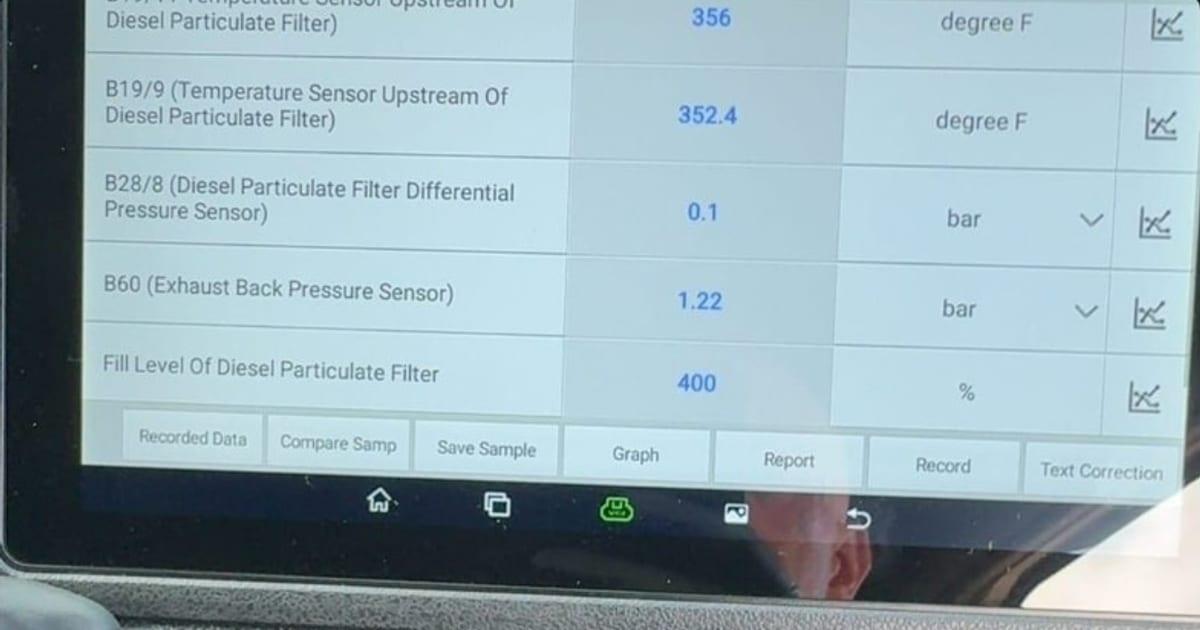
A good example came into the workshop recently. A Mercedes A200 diesel, brought in by a Stourbridge customer because it had no power. When we plugged in the diagnostics, the filter was reading 400 per cent full. That is the photo at the top of this page. I will come back to what caused it, because it was not the way the car was being driven.
Got a DPF light on now? We diagnose and sort blocked filters at our Dudley workshop, and find out why the filter blocked before anything gets replaced. Everything we do is on our DPF cleaning and repair in Dudley page.
What a DPF actually does
The diesel particulate filter sits in the exhaust and catches the soot a diesel engine makes, so it does not come out of the tailpipe as black smoke. Almost every diesel car and van built since 2011 has one, and plenty from before that.
A filter that only ever caught soot would block up in no time, so it has to empty itself. It does that by getting hot enough to burn the soot off into a fine ash. That is called regeneration, and it happens in two ways.
- ▸Passive regeneration. On a longer run at a steady speed, the exhaust gets hot enough on its own to burn the soot as it goes. You never notice it.
- ▸Active regeneration. When the soot builds up past a certain level, the engine management deliberately raises the exhaust temperature, usually by adding a little extra fuel, to burn it off. This needs the car to keep running at a decent speed for a while to finish.
Both depend on heat and time, which is exactly what short winter journeys do not give it.
Why winter is worse
A cold engine takes longer to warm up, and a cold exhaust takes longer still. On a frosty morning, a ten-minute trip can finish before the exhaust is anywhere near hot enough to regenerate.
Then the car tries an active regeneration, and you switch off on the drive halfway through it. It tries again next time, and you switch off again. Each interrupted attempt leaves more soot behind, and the filter keeps filling.
There is a less obvious winter problem too. If the engine's thermostat is stuck open, the engine never gets properly hot in cold weather. The heater is lukewarm, the temperature gauge sits low, and the DPF can never get hot enough to clear. If your heater has been poor and your DPF light keeps coming on, those two things may well be the same fault. I covered the heater side in car heater not working.
Signs your car is regenerating
You do not have to guess. While an active regeneration is running, many cars:
- ▸keep the cooling fan running after you switch off
- ▸idle slightly higher than usual
- ▸give off a hot, acrid smell from the exhaust
- ▸turn the stop-start system off
- ▸use a bit more fuel for that trip
If you notice those signs, keep driving if you can rather than parking up. Letting it finish is the best thing you can do for the filter.
What to do when the DPF light comes on
The DPF light is amber, and on most cars it looks like a box with dots inside it. My dashboard warning lights guide has it alongside the others.
When it comes on, the car is asking for a proper run:
- Pick a dual carriageway or motorway. Round here, the M5 or the M6 does the job.
- Drive for around twenty minutes at a steady speed, holding about 2,000rpm or more. A gear lower than you normally would helps.
- Do not switch off until you are done, even if the light goes out early.
That clears it on most cars. The exact advice varies between makes, so it is worth a look in the handbook. Some cars want a particular speed or a longer run.
When the light will not clear
If you have done two good runs and the light is still on, or it comes straight back within a week, stop. Another run is not going to fix it.
Carry on with short trips and the filter keeps loading until the engine management protects itself. You get limp mode: very little power, sometimes the engine management light as well, and a car that will barely get up a hill.
From there, the options are these.
- ▸A forced regeneration. Using diagnostic equipment, the car is held at a fast idle while the system burns the soot off. It works on a filter that is heavily loaded but not packed solid. We change the oil and filter as part of it, because the extra fuel a regeneration burns ends up diluting the engine oil.
- ▸A clean. When a filter is too full for a regeneration, or full of ash rather than soot, it can be cleaned. Some cleans are done with the filter still on the car. A deeper clean means taking it off.
- ▸A replacement. If the filter is cracked, melted or too far gone, it gets replaced, with a new filter or a professionally cleaned one.
Which one your car needs depends on how full it is and what is in it. That is a scanner job, not a guess.
Why it keeps coming back
This is the part that matters most, and the part that gets skipped.
If a DPF keeps blocking even when the car gets good runs, the filter is rarely the real problem. Something is stopping it from regenerating, or making the engine produce more soot than it should. The common culprits:
- ▸Exhaust temperature sensors. If the system cannot read how hot the exhaust is, it cannot manage a regeneration properly.
- ▸The differential pressure sensor, or its pipes. This is how the car measures how full the filter is. A split pipe or a faulty sensor gives false readings either way.
- ▸A sticking EGR valve. The EGR valve feeds some exhaust gas back into the engine. When it sticks it upsets the combustion and the soot levels.
- ▸Injectors. A worn or leaking injector makes extra soot.
- ▸A thermostat stuck open. As above, the engine never gets hot enough.
- ▸The wrong engine oil. DPF-equipped diesels need a low-ash oil to the right specification. The wrong oil leaves ash in the filter that no regeneration can burn off. If you are unsure what yours should have, when to change your engine oil covers why the specification matters.
- ▸Age and mileage. Even on a perfectly healthy car, ash builds up over a very high mileage, and eventually the filter needs cleaning or replacing.
Clean or replace a filter without fixing the cause, and you pay for it twice.
The A200 that read 400 per cent full
Back to the Mercedes. The customer's complaint was simple: no power. Diagnostics showed the filter reading 400 per cent full, which is not a number everyday driving produces.
The reason was a failed exhaust temperature sensor. With that sensor dead, the system could not manage the regenerations that should have been keeping the filter clear, so the soot just kept building. When we took the filter off the car to inspect it, it was completely blocked.
The customer chose a secondhand filter that we had professionally cleaned, which saved a good amount against a new one. That went on with a new lambda sensor and a new exhaust temperature sensor. Then we cleared all the fault codes, reset the system values to zero and road tested it. The difference was unbelievable. It drove perfectly.
To be clear, the filter was replaced, not deleted. You can watch me talk through the A200 job in under a minute.
The point of that job is the sensor. Fitting a clean filter and leaving the dead sensor in would have had that car back with a blocked DPF within months.
Do DPF cleaning additives work?
They can help a filter that is only partly loaded, alongside a proper run, because they help the soot burn at a lower temperature. They will not unblock a filter that has already put the car into limp mode, and they will not fix a faulty sensor or a sticking EGR valve. Treat them as maintenance, not a repair.
Deleting a DPF is illegal
You will see adverts for DPF removal. If your car was built with a filter, it is illegal to drive it with the filter taken out, and a missing filter is an MOT failure. The government says the fine can be up to £1,000 for a car and £2,500 for a van.
Since 2018, any visible smoke from the exhaust of a diesel that has a DPF is also a major fault at the MOT.
We do not remove or delete DPFs. A filter that is blocked gets regenerated, cleaned or replaced, and the reason it blocked gets fixed.
Not to be confused with the glow plug light
Diesel drivers often mix the DPF light up with the glow plug light. The glow plug light is the amber coil symbol that comes on briefly when you turn the key, while the engine warms itself up to start. That is normal. If it flashes while you are driving, on many cars that is the engine flagging a fault, often nothing to do with the glow plugs themselves, and it needs reading. It is a different light from the DPF one.
What we do
If your DPF light is on and a good run has not cleared it, or the car is already in limp mode, tell us the make, model and what it is doing. We always start with diagnostics, which is £45. A DPF light can come on for a number of reasons, and that is what tells us how full the filter is and why it blocked.
From there:
- ▸Forced regeneration: £250, including an oil and filter change.
- ▸DPF clean off the car: from £299, depending on the car. We take the filter off and refit it here, and a specialist cleaner just round the corner does the clean.
- ▸Replacement filter, or fixing the cause: quoted after diagnosis.
You get a fixed price before any work starts. DPF work is ramp work, so it is done at our Dudley workshop. We can collect the car from across Dudley, Stourbridge, Halesowen and the rest of the Black Country and bring it back. All of it is on our DPF cleaning and repair page, or see how our car diagnostics work.
And if you are a diesel driver doing mostly short trips this winter, the cheapest thing you can do is give the car a proper run every week or two. The filter will thank you for it.