This summer was the hottest on record for the UK. The Met Office has it provisionally at a 16.5°C mean, beating the record set only last year, and from June to the end of August my phone was all about air-con. Blowing warm, smelling musty, needing a regas.
Which means that since about April, almost nobody has touched the other end of the dial.
The heater is the one system in the car that can be broken for months without anyone noticing. Then the first cold, wet morning comes round, the screen mists up on the school run, and that is when people find out.
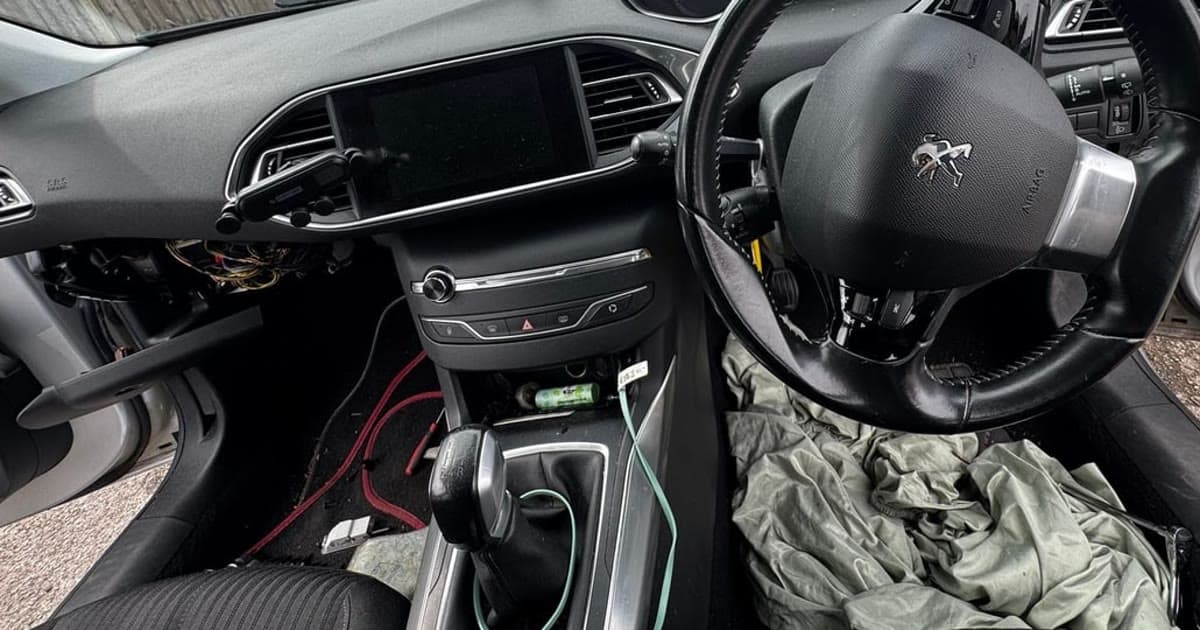
I had a good example recently. A 2015 Peugeot 308 in Quarry Bank with no heater blower at all. It had stopped working in October last year, and the owner had gone the best part of a year without finding anyone willing to take the job on. You can watch me talk through the 308 blower job in under a minute, and I will come back to why nobody wanted it.
So before the weather turns, here is what the common heater symptoms mean, the five-minute check worth doing this week, and why now is a better time to sort it than the first frost.
Why a working heater matters more than it sounds
People think of the heater as comfort. In winter it is visibility.
The blower pushes air across the inside of the windscreen, and the heat is what lets that air clear condensation and frost. Without both, a misted screen stays misted. The Highway Code is clear that before you set off you must be able to see, and must clear all snow and ice from all your windows. A car that will not demist either keeps you sat on the drive or tempts you into driving off with a porthole wiped in the glass, and neither is a good start to a December morning.
How your heater actually works
It helps to know there are three separate parts, because the symptom usually tells you which one has failed.
- ▸The heat. Hot coolant from the engine runs through a small radiator behind the dashboard called the heater matrix. No hot coolant, no heat.
- ▸The fan. The blower motor pushes air through the matrix and out of the vents. On most cars the fan speeds are controlled by a blower resistor or a small control module.
- ▸The flaps. Small motors called actuators move flaps inside the dash to mix hot and cold air and send it to the screen, the face vents or the footwells.
Fan only works on full speed
This is the classic one, and it is nearly always the blower resistor.
The lower speeds run through the resistor to slow the motor down. The top speed bypasses it. So when the resistor fails, the lower speeds stop working and full blast carries on as if nothing had happened. People live with it for months because the car still demists, just very loudly.
It is worth fixing rather than ignoring. A resistor that has burnt out can be a sign the blower motor is getting tired and drawing more current than it should, and if so a new resistor on its own will not last.
No air at all, on any setting
Now it is the fuse, the relay, the wiring or the blower motor itself. A blown fuse is the first thing to check and the cheapest thing to find.
If it is the motor, the cost comes down to where the manufacturer put it. On a lot of cars it sits behind the glove box and is reasonably quick to get at. On the 308 it is buried behind the dashboard. To reach it we had to take out most of the dash, the steering wheel, the steering column, the clutch and brake pedals, the housing and the glove box, and then put it all back together. About two hours in total.
That is why the owner could not find anyone to do it. The part is usually the easy bit. It is the access that puts people off.
Air is blowing, but it stays cold
The fan is fine, so the problem is the heat. The usual suspects:
- ▸Low coolant. Check the level in the expansion tank with the engine cold. If it is low and keeps going low there is a leak somewhere, and topping it up every week only delays finding it.
- ▸An airlock. Air trapped in the cooling system, often after coolant work, can stop hot coolant reaching the heater matrix.
- ▸A thermostat stuck open. The engine takes ages to warm up, the temperature gauge sits lower than usual and the heater is only ever lukewarm. It costs you fuel as well.
- ▸A blocked heater matrix. Sludge or corrosion restricts the flow through it, so the heat never builds.
- ▸A flap that has stopped moving. If you hear clicking or ticking from behind the dash when you change the temperature, an actuator has often given up.
Hot on one side, cold on the other
On cars with separate driver and passenger temperatures, this is usually a flap actuator on one side. Low coolant can do it too, so check the level before assuming the worst.
A sweet smell, a greasy screen or a damp footwell
This one I would not leave. A sweet, syrupy smell in the cabin, a greasy film on the inside of the windscreen that smears when you wipe it, or a wet carpet in the passenger footwell usually means the heater matrix is leaking coolant into the car.
You are breathing that vapour, the film makes the screen harder to clear rather than easier, and a cooling system that is losing coolant can overheat the engine. It needs finding and fixing properly.
Weak airflow on every setting
If the fan sounds like it is working but not much comes out of the vents, look at the cabin filter, sometimes called the pollen filter. A clogged one strangles the airflow. It is a cheap part and usually a quick job.
The screen mists up even though the heater works
Use the air-con. Yes, in winter. The air-con dries the air as well as cooling it, so running it with the heater on clears a misted screen far faster than heat alone. It also keeps the system healthy through the cold months, which I went into in my air-con post from May.
The five-minute heater check to do this week
Do this before a short drive:
- With the engine cold, check the coolant is between the minimum and maximum marks.
- Once the engine has warmed up, turn the temperature to hot and go through every fan speed. Every one should work.
- Switch between screen, face and footwell. Air should come out where you asked for it.
- If the car has separate driver and passenger controls, check both sides get hot.
- Sniff. A sweet smell is a warning, not a quirk.
- Put your hand on the passenger footwell carpet. It should be dry.
If all of that is fine, you are in good shape. If anything is not, better to find out in September than on a frosty Monday.
Why now, and not November
Three reasons.
First, everyone finds out at once. The first cold snap turns a trickle of heater calls into a queue.
Second, some of these jobs are not quick, as the 308 shows. Better to have a dashboard-out job done on a mild day with time to spare than squeezed in when you need the car working tomorrow.
Third, the summer was hard on cooling systems. My dad Keith covered what a heatwave does to a car, and a cooling system that has been working flat out since June is worth a look before it has to keep you warm as well.
What we do
The heater and demister are part of every winter check we do. We run them up to temperature and make sure the screen actually clears, alongside the battery load test, antifreeze, tyres, brakes, lights and wipers.
If your heater has already stopped working, send us the make, model and what it is doing. We will tell you straight whether it sounds like a fuse, a resistor or a dashboard-out job, and give you a fixed price before anything is started.