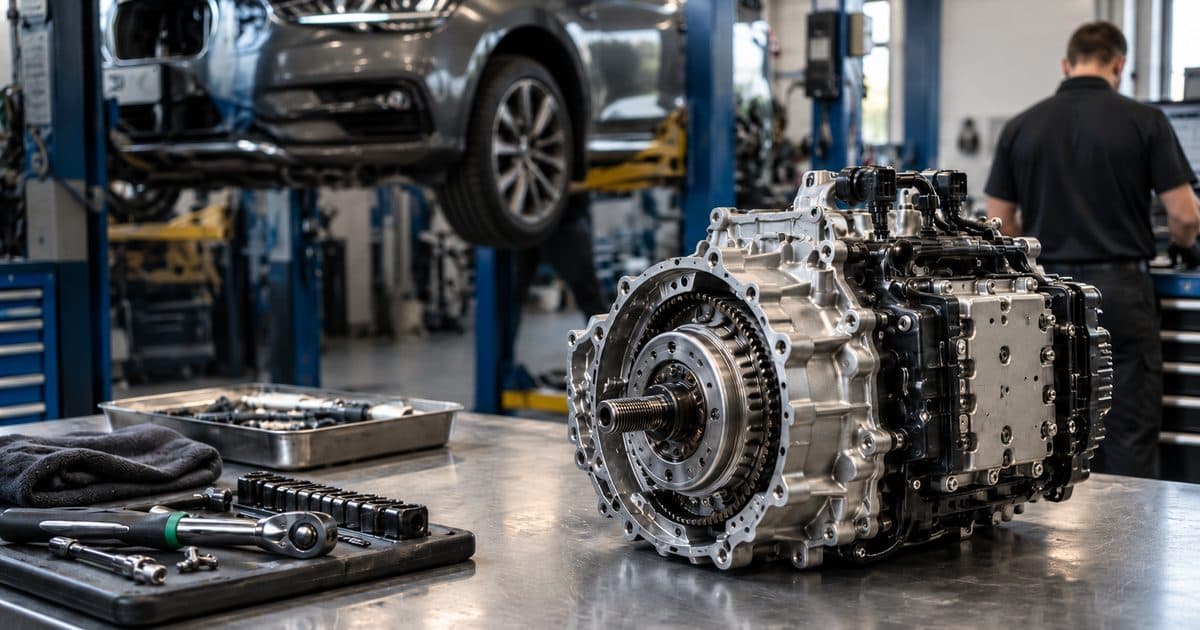
If your DSG has started juddering when you pull away, hesitating before it picks a gear, or flashing a gearbox warning at you, it is very easy to assume the worst.
Usually something along the lines of: "That's going to need a gearbox."
Not necessarily.
A DSG is a complicated piece of kit, and several different faults can produce near-identical symptoms from the driver's seat. Some are relatively straightforward. Others involve the clutch pack or the mechatronic unit and need proper workshop time.
The part that matters is finding out what has actually failed before anyone starts replacing expensive components.
A 2018 Arteon we had in recently is a good example. It was getting stuck in 2nd and 5th, which sounds like a gearbox, and turned out to be failed solenoids in the mechatronic unit that we reconditioned rather than replaced. You can watch me talk through the Arteon repair in about a minute.
We work on DSG and S tronic gearboxes regularly at Your Local Mechanic, so here is what I look for when one starts misbehaving, what the symptoms tend to mean, and what the repairs realistically cost.
What actually is a DSG gearbox?
DSG stands for Direct-Shift Gearbox.
Rather than a conventional automatic with a torque converter, a DSG is a dual-clutch gearbox. In simple terms, one clutch handles one set of gears and a second clutch handles the others. While you are driving in one gear the box has already lined up the next one, which is why a healthy DSG changes gear so quickly and smoothly.
Audi generally calls the same broad family of dual-clutch technology S tronic.
There is not, however, one single DSG gearbox. Volkswagen Group has used a number of different families over the years, including:
- ▸DQ200
- ▸DQ250
- ▸DQ380
- ▸DQ381
- ▸DQ500
- ▸DL382
- ▸DL501
- ▸hybrid variants such as the DQ400e
They have different clutch designs, torque capacities, servicing requirements and common faults. Knowing that your car "has a DSG" is only the start of the diagnosis, and I will come back to which is which further down.
1. Juddering when you pull away
This is the symptom customers describe most often.
You release the brake or start to accelerate and, instead of pulling away cleanly, the car shudders or judders. It is often more noticeable:
- ▸when the gearbox is hot
- ▸in slow traffic
- ▸when reversing
- ▸on an incline
- ▸when pulling away gently rather than accelerating hard
Clutch wear can cause it, but it is not the only possibility. The gearbox's adaptation values, the mechatronic's control of clutch pressure and, on a wet-clutch box, the condition of the fluid can all affect how the clutch engages.
So juddering does not automatically mean "new clutch". It means the gearbox needs diagnosing, and the sooner the better, because it is the earliest useful warning a DSG gives you.
2. Jerky or harsh gear changes
A healthy DSG should change gear without you thinking about it. If it has started banging into gear, hesitating between changes or shifting much more harshly than it used to, something has changed.
Depending on the gearbox, the cause can involve:
- ▸gearbox fluid condition or level
- ▸clutch operation
- ▸clutch adaptation
- ▸hydraulic pressure
- ▸mechatronic control
- ▸sensors
- ▸mechanical wear
This is exactly why I would rather see the car and scan it than diagnose a DSG from a description over the phone. Several very different faults feel remarkably similar from behind the wheel.
3. A delay before Drive or Reverse engages
You select D or R and nothing happens. Then, a second or two later, it engages, sometimes with a thump.
That delay is worth investigating. A DSG relies on the clutch and mechatronic systems working together to take up drive, so a delay tells us something useful about which part of that system is not behaving.
If the delay is getting longer, do not simply learn to live with it. Gearbox problems rarely improve through being ignored.
4. A flashing PRNDS display or gearbox warning
A flashing gear display, PRNDS indicator or transmission warning is the car telling you the gearbox control system has detected something it does not like.
Sometimes the car carries on driving. Sometimes it restricts which gears you can have. Sometimes you lose drive altogether.
The warning itself does not tell us which component has failed. The useful information is the fault codes and live data stored in the car's control units. A proper diagnostic scan lets us read those rather than guessing from a dashboard light, and the codes logged at the moment it happened are the best evidence there is.
5. The DSG goes into limp mode
Limp mode is the car protecting itself after detecting a fault. You might find:
- ▸only certain gears are available
- ▸the car will not change gear normally
- ▸performance is heavily restricted
- ▸the gearbox warning appears
- ▸switching the ignition off and on makes it disappear for a while
That last one catches people out. The fact that a restart clears it does not mean the fault has gone. If the gearbox has logged something serious enough to restrict itself, we want to know why before it does it again somewhere less convenient.
Being left with only certain gears is also what a failing mechatronic unit can do. The Arteon in our workshop video was holding 2nd and 5th for exactly that reason, and the fix was inside the unit, not a new gearbox.
6. Loss of drive
One of the more serious symptoms. The engine runs, you select a gear, and the car either does not move or loses drive intermittently.
Across the DSG range this can come from the clutch, the mechatronic, the hydraulics, the electrics or the mechanical parts of the gearbox. At this point, continuing to drive it in the hope it sorts itself out is rarely a good idea. Get it diagnosed.
7. Slipping, or the revs flaring between gears
If the engine speed rises without the car accelerating to match, or the revs flare during a change, clutch slip may be involved. You will often notice it first:
- ▸under hard acceleration
- ▸climbing a hill
- ▸once the gearbox is warm
- ▸with more load in the car
- ▸in particular gears
The question is not simply "is the clutch worn?" It is "why isn't the gearbox transferring drive properly?" Those can have different answers, and only one of them involves a clutch pack.
What is a DSG mechatronic unit?
You will hear the word mechatronic a lot once people start talking about DSG faults.
Think of it as the gearbox's control centre. It combines the electronic control module with the hydraulic valve body that manages gear selection and clutch operation, and it is constantly using information from sensors and other vehicle systems to decide what the gearbox should do next.
When something in that process fails, symptoms can include:
- ▸flashing gearbox warnings
- ▸limp mode
- ▸harsh changes
- ▸failure to select gears
- ▸intermittent loss of drive
- ▸delayed engagement
- ▸gearbox behaviour that seems random
But this is the important bit:
A DSG warning does not automatically mean the mechatronic unit needs replacing
And a mechatronic fault does not automatically mean the whole gearbox needs replacing either.
It needs diagnosing first. Sticking solenoids, pressure-control problems, sensor and wiring faults can often be repaired at the unit. Where an individual fault can sensibly be fixed, that is considerably better than throwing a complete gearbox at the problem.
A real DSG repair from our workshop
Here is what that looks like on the ramp. We had in a 2018 Volkswagen Arteon 2.0 TDI. The customer had noted it was getting stuck in 2nd and 5th gear.
After the diagnostics, we found the pressure solenoids had failed in the mechatronic unit itself. So the unit was fully reconditioned and repaired, put back in the box, and the oils done.
Two things are vital on these when you refit the mechatronic unit. You have to warm the car up properly to get the correct level of oil in the gearbox, and you have to do the basic adaptions to get all the gears synchronised and working properly again. Miss either and a sound repair will still shift badly.
Customer collected, and that was it. No replacement gearbox, and no new mechatronic unit either. The photos from the job are on our DSG repair page, and there is a short video of the Arteon repair with the mechatronic unit on the bench.
Which DSG gearbox does my car have?
This is where the terminology gets confusing, so here is the short version of each family. If you want the full run-down of what each one is fitted to and what to watch for, it lives on our DSG repair page.
DQ200
A seven-speed dry-clutch DSG used in many smaller-engined Volkswagen Group cars. Commonly associated with the gearbox identifiers 0AM and 0CW. The mechatronic is its known weak point.
DQ250
A six-speed wet-clutch DSG fitted to a huge range of VW Group cars. Common identifiers are 02E and 0D9. Genuinely tough when it is serviced, and unforgiving when it is not.
DQ380 and DQ381
Later seven-speed wet-clutch DSGs found in plenty of newer VW Group models. The 0GC identifier is the one usually associated with DQ381 applications.
DQ500
A seven-speed wet-clutch gearbox built for higher-torque applications, from Transporters to high-performance Audi and VW models. Common identifiers are 0BH and 0BT.
DL382
This is where Audi S tronic gets interesting. The DL382 is a longitudinal seven-speed dual-clutch transmission used in Audi applications including versions of the A4, A5, A6 and Q5, with identifiers such as 0CK, 0CL and 0CJ. It is a different design from the transverse DQ boxes above and has to be diagnosed on its own terms.
DL501
Another longitudinal seven-speed Audi S tronic, commonly associated with the 0B5 identifier and used across a range of higher-output Audi applications.
You do not need to work any of this out before booking. Give us your registration and we will establish what transmission is actually fitted to your car.
What about the hybrid DSG in a Golf GTE?
Plug-in hybrid VW Group cars brought another variation on the idea.
The DQ400e, commonly associated with the gearbox code 0DD, is a six-speed DSG designed for hybrid applications such as the Golf GTE and its relatives.
It is more than a normal DSG bolted to a hybrid engine. Electric-drive components form part of the transmission itself, so anything beyond a diagnostic scan involves the high-voltage system and the training, equipment and procedures that go with it. Hybrid electronics are my side of the business, so we can diagnose these, but we confirm the scope of any repair from the registration before booking rather than promising the job over the phone.
Does a DSG need servicing?
Some do, and the exact requirement depends on the gearbox and the vehicle.
This is where I would be careful with blanket statements like "every DSG needs an oil change every X miles". Different DSG families have different designs and different manufacturer schedules.
Wet-clutch boxes in particular use the transmission fluid as part of how they work. It runs the clutches and the mechatronic hydraulics as well as lubricating, so the correct oil, fill procedure, level and temperature all matter. If you are unsure when yours was last done, the sensible thing is to identify the exact gearbox first and check the schedule for that car.
A proper DSG service can include:
- ▸correct-specification DSG fluid
- ▸gearbox filter where the box has one
- ▸setting the fluid level using the correct temperature procedure
- ▸checking for leaks
- ▸a diagnostic scan
- ▸gearbox adaptations or basic settings where appropriate
- ▸a road test
Using the right fluid and the right procedure matters every bit as much as changing it. A DSG service done with the wrong oil, or filled to the wrong level, is not a service.
Can driving with a DSG fault make it worse?
Potentially, yes.
There is a big difference between "I noticed one slightly unusual gear change" and "the gearbox warning is flashing and the car keeps losing drive".
If you have any of these, I would avoid unnecessary driving until it has been checked:
- ▸loss of drive
- ▸severe slipping
- ▸loud mechanical noises
- ▸repeated limp mode
- ▸a flashing gearbox warning
- ▸difficulty selecting Drive or Reverse
A relatively contained fault can become a considerably more expensive one if continued use damages other components. If you are unsure which camp you are in, ring us and describe exactly what the car is doing.
How much does a DSG gearbox repair cost?
The question everyone understandably wants answered first.
The honest answer is that "DSG repair" is not one repair. A gearbox service is very different from a mechatronic repair. A mechatronic repair is very different from a worn clutch pack. And all of those are very different from an internal mechanical failure.
At Your Local Mechanic:
- ▸DSG diagnostics start from £45
- ▸DSG oil and filter servicing starts from £249
- ▸mechatronic work is quoted after diagnosis
- ▸clutch repairs are quoted after diagnosis
The important part is that we diagnose it before asking you to authorise anything expensive. You get an explanation of what we found and a fixed price before the repair goes ahead, and caught early, most DSG problems cost a fraction of the replacement gearbox people fear when they first search for this.
Does a faulty DSG always need replacing?
No.
This is probably the biggest misconception around automatic gearbox faults. People hear "gearbox fault" and immediately picture a replacement transmission costing thousands.
Sometimes a gearbox really does have serious internal damage. But DSG symptoms very often come from components and systems that can be repaired individually, and replacing a complete gearbox before the actual failure has been identified is an expensive way to guess.
That is why we would much rather spend the time establishing the fault than make an expensive assumption. And if your gearbox genuinely needs a specialist internal rebuild that we do not undertake ourselves, we will tell you that too.
Does the car have to come in to be diagnosed?
It does, and it is not a long job.
A diagnostic scan, a proper description of the symptoms and a road test tell us a great deal. We collect the car, do that at the workshop and bring it back. It is often enough to answer the question you actually have, which is how bad is it. If the car will not drive at all, we come out to it and recover it in.
The more substantial DSG work, particularly clutch, mechatronic and anything involving gearbox removal, belongs in the workshop with the ramps and the clean environment it needs. For those jobs we collect the car from across Dudley, Stourbridge, Halesowen and the surrounding Black Country and bring it back when it is done. More on how the mobile side works if you are curious.
Buying a used car with a DSG?
One last thing, because it comes up constantly. A serviced DSG is a good gearbox. Most of the horror stories trace back to fluid nobody changed, or an early warning sign that was driven through for a year.
If you are looking at a used DSG car, ask for the gearbox's service history specifically, not just the engine's, and have it scanned before you hand over the money. Stored fault codes and worn clutch adaptation values will tell you far more than a ten-minute test drive. That is exactly what a pre-purchase inspection is for.
DSG playing up? Diagnose it before guessing
Juddering, delayed engagement, jerky shifts and gearbox warnings are symptoms. They are not a diagnosis.
If your Volkswagen, Audi, SEAT, CUPRA or Škoda DSG or S tronic gearbox is not behaving, tell us what it is doing and we will start there. We will identify the gearbox, diagnose the problem and explain what it actually needs before you commit to a repair.
Everything we do on these boxes, with prices, is on our DSG gearbox repair and diagnostics page. Or call us on 07453 957641 or message us on WhatsApp with your registration and what the car is doing.
We cover Dudley, Stourbridge, Halesowen and the surrounding Black Country, with workshop collection for the bigger gearbox jobs.